Dental Crowns and Bridges

Restoring your smile with dental crowns and bridges
Dental crowns and bridges are two of the most reliable tools in restorative dentistry; crowns rebuild a tooth that’s been broken or badly decayed, and bridges replace one that’s already gone. At Plancich Dental, we’ve been doing this work for Tacoma, WA and Lakewood, WA families for over 30 years. Come in, and we’ll tell you exactly what you’re dealing with.
DENTAL CROWNS
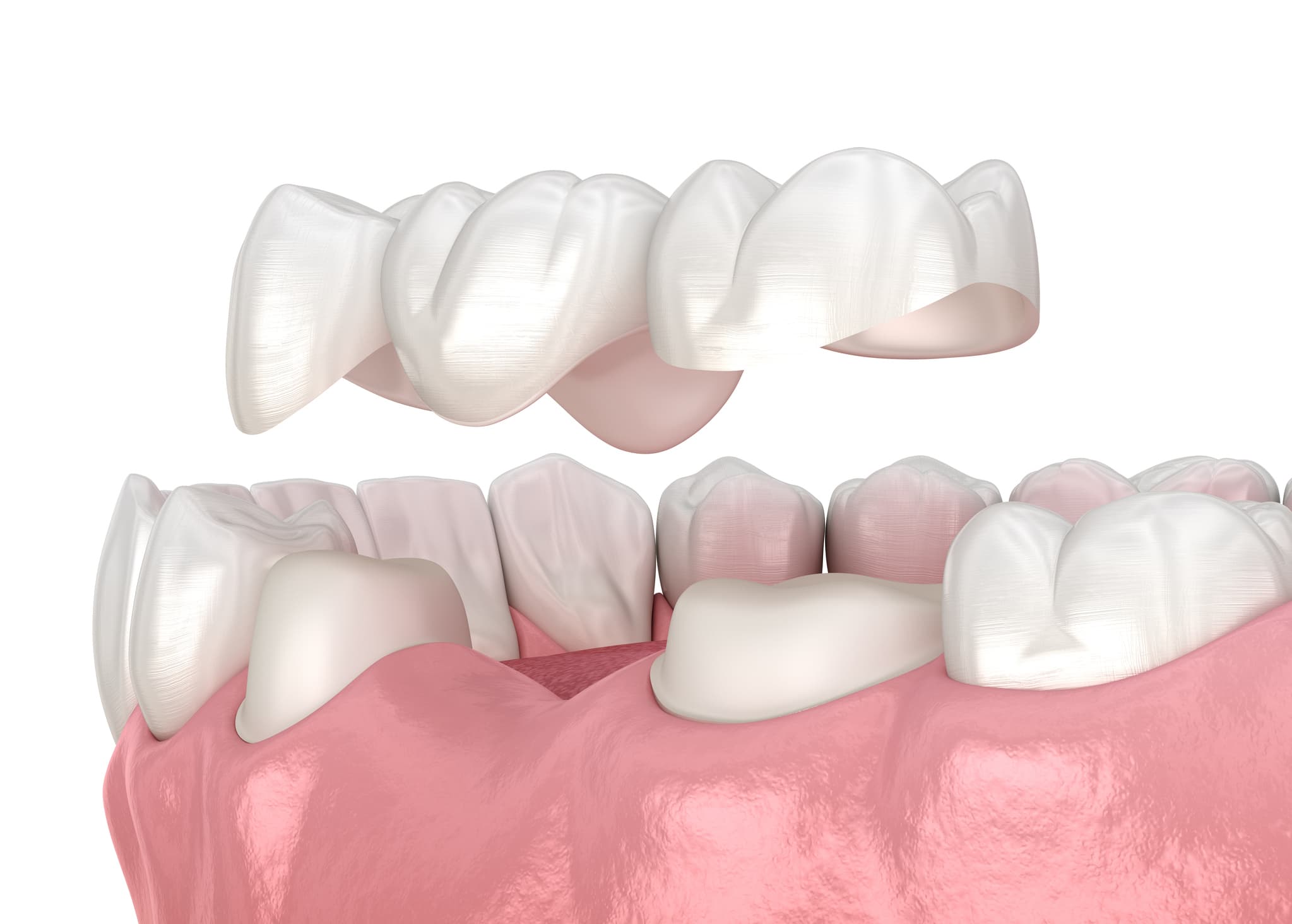
A crown saves a tooth that a filling can’t
A dental crown is essentially a custom-fitted cap placed over a damaged tooth, covering it completely to restore its shape, strength, and appearance. Imagine a tailor-made helmet protecting an athlete; the crown covers the visible portion of the tooth down to the gum line, reinforcing its structure and preventing further breakage.
The cap is made from porcelain and matched to your surrounding teeth in color, so it blends in. Most patients tell us you really can’t tell which tooth has it. When decay or a crack has taken enough of a tooth that a filling won’t hold, a crown covers the whole thing and protects what’s left. A crown can keep a tooth healthy for decades longer than it would have otherwise.
Signs a dental crown may be the best option
A crown is usually the right call when:
- A damaged tooth has a crack or fracture a filling can’t stabilize
- Decay or breakage has compromised more than half the tooth structure
- A tooth has had root canal treatment and needs long-term protection
- A large, failing filling is putting the remaining tooth at risk
- Broken teeth need rebuilding from what remains
- The tooth is anchoring a dental bridge
DENTAL BRIDGES
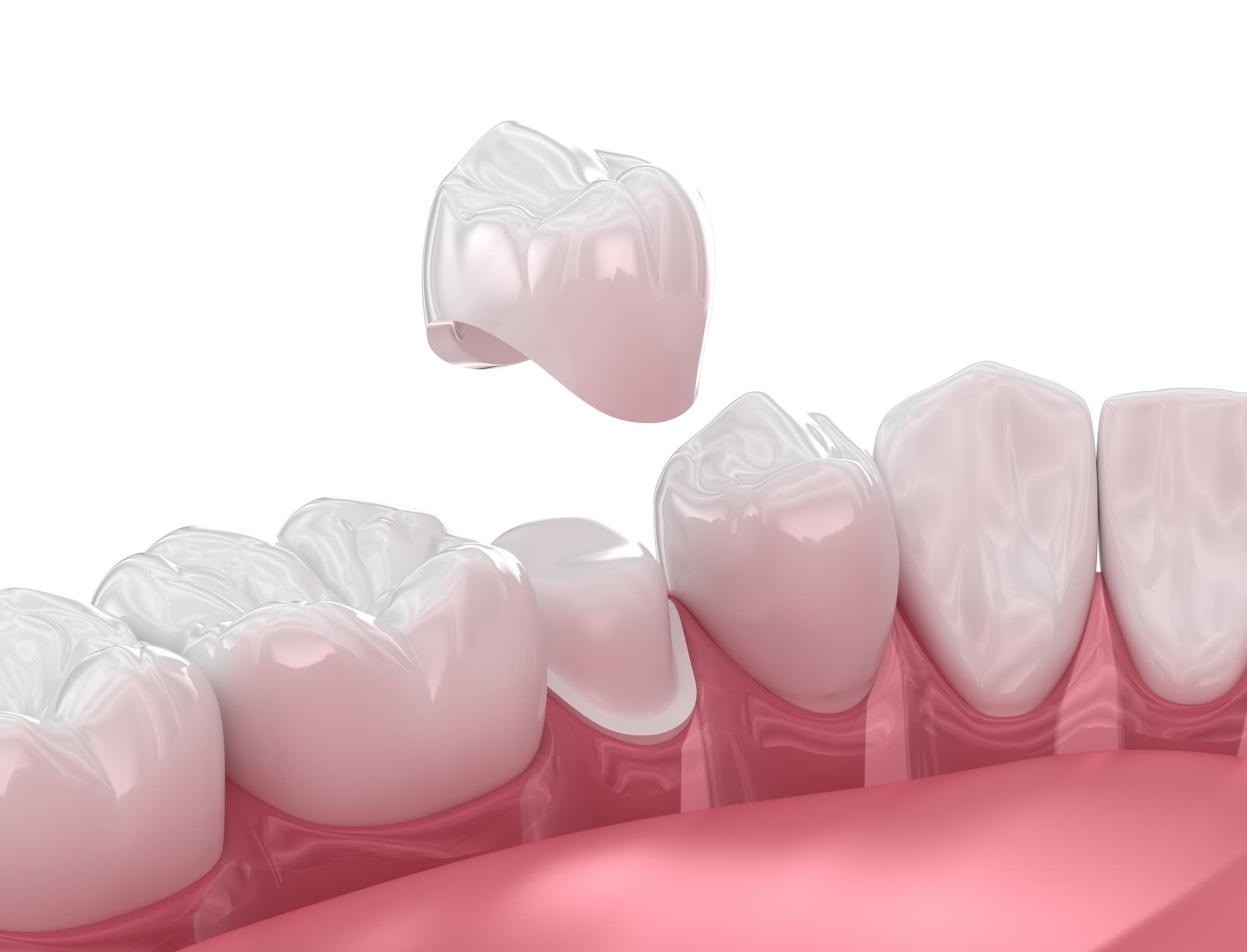
A bridge fills the gap left by a missing tooth
A dental bridge uses two crowns on the teeth on either side of a gap to hold an artificial tooth, called a pontic, in the space where the missing tooth used to be. Unlike dentures, a bridge is fixed in place so it doesn’t come out, but rather functions more like a natural tooth that most people adapt to quickly.
The neighboring teeth get shaped to receive their crowns. Once everything is bonded in, the bridge becomes part of your bite. Traditional bridges have been the standard way to replace missing teeth without surgery for decades, and when the surrounding teeth are healthy, they still work very well.
Signs a dental bridge may be the best option
A bridge is worth considering when:
- You’re missing one or two teeth and the teeth on either side are in good shape
- A dental implant isn’t the right fit right now (medically, financially, or timing-wise)
- You want a permanent dental restoration without surgery
- You’re replacing an existing bridge that’s worn out
One more thing worth knowing
When a tooth goes missing and isn’t replaced, the teeth around the gap tend to shift. The tooth on the opposite side can drift, too. What starts as one missing tooth can become a bigger bite and oral hygiene problem over time. A bridge stops that from happening.
Why replacing missing teeth matters
When a gap is left empty, your jawbone can begin to deteriorate, and neighboring teeth will naturally tilt into the open space, throwing off your entire bite. This misalignment often leads to TMJ pain and increased wear on your healthy teeth.
What to expect at your appointment
The process of getting a crown or bridge is straightforward and focused on your comfort. Most patients find the experience much easier than they anticipated. Here’s how it goes:
Step 1: The initial consultation
Your journey begins with a thorough exam. Using advanced digital imaging, your dentist creates a 3D map of your mouth. This eliminates the need for messy, “goopy” impressions and ensures that your new restoration will fit with microscopic precision.
Step 2: Preparation and temporary placement
Next, the tooth is gently reshaped to allow the crown or bridge to sit flush with your gum line. You’ll be fitted with a temporary restoration that looks and feels natural, protecting your tooth while a specialized lab crafts your permanent piece.
Step 3: Final fitting and bonding
Once your custom restoration arrives, you’ll return for the final fitting. Your dentist will check the bite and color match before permanently bonding it into place. You’ll walk out of the office ready to eat, speak, and smile without hesitation.
Choosing between a crown, bridge, or dental implant
There’s no single right answer, as it depends on the tooth, the condition of the teeth next to it, the bone underneath, and what matters most to you. Here’s a straightforward look at how the three options compare.
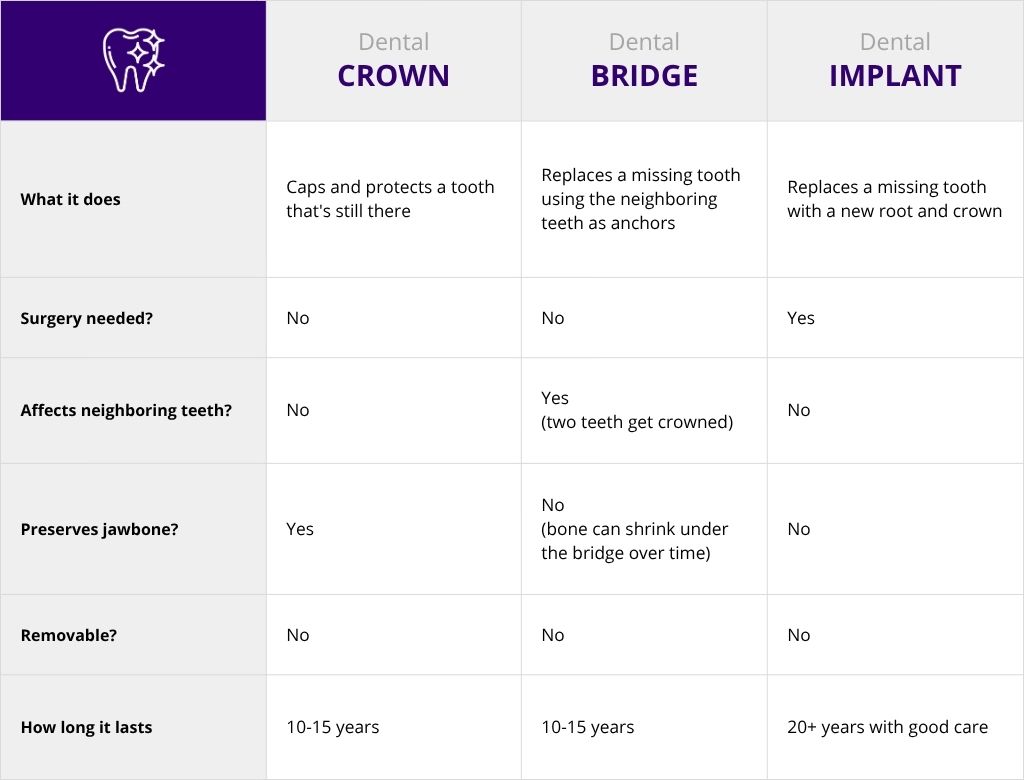
If the tooth is damaged but the root is still healthy, a crown is almost always the simpler choice. If the tooth is gone, the decision between a bridge and a dental implant comes down to the health of the neighboring teeth, the bone, your timeline, and your own preference. We’ll go through it with you in detail so there’s no pressure in either direction.
A crown lasts as long as you maintain it
Most porcelain crowns and bridges last 10-15 years and sometimes a good deal longer. The crown itself rarely fails. What usually causes a problem is new decay creeping in at the gumline, or the gum slowly pulling back and exposing the edge of the crown.
The same oral hygiene habits that protect your regular teeth protect a crown or bridge, too:
- Brush twice a day.
- Floss carefully around the crown, and thread floss under the bridge (that step matters and most people skip it).
- Come in for your regular cleanings. We check the fit every time you’re in.
Questions we hear most about crowns and bridges in Lakewood & Tacoma, WA
How do I know if I need a crown or just a filling?
A filling works when the damage is limited and there’s enough healthy tooth left to hold it. A crown makes more sense when a crack can’t be fixed with a filling, when decay has taken most of the tooth, when a large old filling has failed, or when the tooth has had a root canal. If you’re not sure, come in and we’ll give you a straight answer.
How many appointments does this take?
Usually two, about one to two weeks apart. At the first one, the tooth gets prepared and a temporary crown or temporary bridge goes in. At the second, the permanent restoration is bonded in place and the bite is checked. You have a functional tooth after both visits.
Will the crown look like a real tooth?
Yes. Porcelain crowns are very good at looking like real teeth because they share the same color and they catch light in a similar way. We match the shade to your surrounding teeth before anything gets made. Most people tell us nobody notices, which is exactly the point.
How long do crowns and bridges last?
Most last 10–15 years with regular care. Some last longer. The most common reason one needs replacing earlier is new decay sneaking in at the gumline, or grinding that chips the porcelain over time. Brushing, flossing, and keeping up with your cleanings makes a real difference.
Does getting a crown hurt?
The tooth prep is done while you’re numb, and most of our clients find it straightforward. It’s normal to have some sensitivity for a few days after. Once the permanent crown is in and settled, it shouldn’t give you any ongoing trouble. If you tend to get anxious about dental work, just tell us, and we can talk through options.
What happens if I don’t replace a missing tooth?
The teeth around the gap start to shift toward it over time. The tooth directly above or below can drift too. That shifts your bite, makes it harder to keep teeth clean, and the jawbone under the gap starts to shrink without a root to stimulate it. A dental bridge or dental implant stops all of that from happening.
Does insurance cover dental crowns and bridges?
Most dental insurance plans cover some portion of crowns and bridges—often around 50% after your deductible. Coverage on bridges can vary a bit more depending on the plan. We’ll verify your benefits ahead of time and let you know what to expect before your appointment.
We want cost to be a conversation, not a surprise.
MAKE AN APPOINTMENT
Ready to take care of it? We’re ready when you are.
You don’t need to walk in knowing exactly what you want. If you’ve been putting off a broken tooth or a gap because you weren’t sure what was involved, or what it would cost, come in. We’ll walk you through it.
Our Tacoma and Lakewood offices are accepting new patients now.
Make an Appointment
RELATED SERVICES
Other restorative treatments you may be looking into
Dental Implants Root Canal Treatment DenturesOur Practice
Use our online form and we will help you find a time that fits your schedule.
Learn More